Tuesday, August 18, 2015

Has Growth in Antarctic Sea Ice Extent Suddenly Halted?

Antarctic sea ice extent has barely increased so far this month. In a typical year, Antarctic sea ice extent would have increased by over a million square kilometers during the first half of August. There is no telling whether the results of the last few weeks is just an aberration or the start of a trend.

However, the minimal growth of Antarctic sea ice extent makes a mockery of claims being made by climate science deniers as recently as last month. A favorite tactic of climate science deniers is to claim that the growth in Antarctic sea ice extent offsets the decline in Arctic sea ice extent. And while this type of comparison was misleading even when the Antarctic sea ice extent was expanding, it is downright absurd this month in which the Antarctic sea ice extent has returned back to it average extent during 1981-2010.


While Antarctic sea ice extent has been flat lining during a winter period when it usually expands, Arctic sea ice extent has been melting faster during the past few weeks than it did during the most recent couple of years.

It seem ludicrous that Christopher Booker of The Telegraph was claiming "How Arctic ice has made fools of all those poor warmists" back on  July 25, 2015. In his article, Booker made of point of indicating Arctic sea ice extent was higher in 2015 than in 2013 and 2014. Well, as one can see from the image below, Arctic sea ice in 2015 has been both above and below that of the previous two years over the course of this year. However, on the date Booker published his article, Arctic sea ice extent was already trending lower than the previous two years, and has stayed lower throughout August. In fact, based on the current trend, it seems likely that 2015 Arctic sea ice extent summer melt minimum will be the 5th lowest in recorded history, and well below the levels of 2013 and 2014. He also made the spurious argument that Antarctic sea ice growth counterbalanced Arctic sea ice declines. Well, that claim goes up in smoke due the sudden halt in expansion of Antarctic sea ice extent this month.

Time will tell whether the increase in Antarctic sea ice extent has come to a halt. It would not be surprising if there is some increase of the ice extent during September or early October, the period when Antarctic sea ice extent reaches it's annual winter maximum. However, it is not unreasonable to speculate that Antarctic sea ice extent may have returned back to its average range. 

Related Articles


Monday, August 17, 2015

The Revised Republican Presidential Candidate Message on Climate Change - "It's natural"

During mid-January, 2016, it will be announced by NASA, NOAA, and the Japan Meteorological Agency that 2015 was the hottest year in recorded history (Given that 5 of the first 7 months during 2015 have been the hottest for their respective history, it is not so much a question of will 2015 be the hottest year in recorded history, but one of "by how much will it be the warmest?"). At this point, it will become pretty difficult for any political candidate to continue to claim that "global warming is a hoax" without losing credibility among all except those that are in deepest denial. A few Republicans, including Donald Trump, James Inhofe and Rick Santorum, may continue to spout the "hoax" myth, but any candidate that wishes to appeal to a mainstream audience will lose credibility if they deny that we live on a warming planet.

A logical mantra for a presidential candidate that wants to appeal both to the Republican base during the 2016 primaries and also to a mainstream audience during the general election, is to indicate the warming of the planet is "natural". This claim that the warmth of 2015 is "natural" can be supported by indicating that it is part of a trend that has been going on in the short term since the end of "the little ice age" and in the long term since the end of the "ice age".

Given that most of the 2016 Republican primaries will be held during winter, the seasonally cold weather will probably dampen the attention drawn by "global warming" and thus make it easier to down play this issue.

Joining the consensus of climate scientists, and agreeing that mankind is contributing to climate change is going to be challenging for any Republican candidate. The problem is that American voters are unlikely to accept a position of indicating that there is a problem, but not recommending taking any action in regard to the problem. And the various solutions proposed to combat climate change are antithetical to conservative Republicans. New and/or stricter regulations that limit carbon emissions are a non-starter. Supporting a carbon tax would almost certainly be political suicide for a Republican candidate in the primaries. According to a Rasmussen Reports poll, 65% of voters would be opposed to actions that cost them more than $100 a year,
Forty-one percent (41%) say they’re not willing to pay anything more in taxes and utility costs to generate cleaner energy and fight global warming. Another 24% are willing to spend only $100 more per year.
Conclusion

Here are some of the positions Republican presidential candidates can espouse on global warming:

1. It's a hoax
2. I'm not a scientist
3. The data is inconclusive
4. Climate change is natural
5. Mankind is contributing to climate change

Of the above, the first (hoax) would be damaging in the general election. The fifth (anthropogenic climate change) would be a vote killer during the primaries. The second and third claims above come across as awfully lame. Thus, the most logical position for a Republican presidential candidate on climate change is the fourth above, that climate change/global warming is natural. It's instructive that Lindsay Graham, the only Republican candidate that suggests climate change denial will be a problem for the party in 2016, is barely registering in the polls

Additional Information

For reference here are links to a couple of sites that:1) explain why the rise in global temperatures is not simply a continuation of a trend, and 2) another site that makes the case that recent "global warming" is natural

1. http://www.carbonbrief.org/blog/2012/05/is-climate-change-all-just-a-recovery-from-a-little-ice-age/

2. http://www.geocraft.com/WVFossils/ice_ages.html

Wednesday, August 12, 2015

Sea Ice - Another Climate Science Denier Claim Melts Away

Climate science deniers are notorious for trying to dismiss climate change by cherry picking dates and massaging data in attempts to obfuscate signs that our planet is warming. In particular, science deniers attempt to downplay the shrinking of Arctic sea ice. They have two tactics for doing so:

  1. claiming that the decline in Arctic sea ice is counterbalanced by growth in Antarctic sea ice. Not only is this claim of  equivalence extremely misleading, currently Antarctic sea ice extent is not showing any increase versus the 1981-2010 average, thus even the misleading equivalence claim goes away (at least for this month)
  2. utilizing the variability of sea ice melt on a year by year basis by making comparisons of a year with extremely low extent to the current year. The clearly downward trend in Arctic sea ice extent can be obfuscated via cherry picking dates due to annual variability.

Arctic Versus Antarctic Sea Ice Extent

As shown in the images below, as of August 2015, Arctic sea ice is well below average extent, while Antarctic sea ice extent is about average. However, even in years when Antarctic sea ice is of above average extent, claims that they are offsetting are incorrect, as explained in posts from The National Snow & Ice Data Center and Skeptical Science. And a critical reason why they are not counterbalancing is the impact the warming arctic is having on the weather in the Northern Hemisphere. A number of researchers are conducting studies to determine if the weird winter weather in recent years resulting from the unusually wavy jet stream is due to reduced ice extent in the Arctic.


As illustrated in the above image, currently Arctic sea ice extent is more than 1.5 million kilometers below the average during 1981-2010. (Although not as low as during the record setting year of 2012).

The above image shows that as of August 2015, Antarctic sea ice has returned to average levels. Thus, the claims of climate science deniers that the sea ice extent at the two poles are offsetting have completely melted away.

Here is an example of the sea ice myth propagated by climate science deniers:
Arctic sea ice loss is matched by Antarctic sea ice gain. In fact, the global sea-ice record shows virtually no change throughout the past 30 years, because the quite rapid loss of Arctic sea ice since the satellites were watching has been matched by a near-equally rapid gain of Antarctic sea ice. Indeed, when the summer extent of Arctic sea ice reached its lowest point in the 30-year record in mid-September 2007, just three weeks later the Antarctic sea extent reached a 30-year record high. (Chris Monckton) 
Another prime example of a climate science denier mangling facts is provided by James Taylor of the Heartland Institute. In particular, note his use of the word "modest" in the quote provided below. Sorry, Mr. Taylor, but the loss of over a million square miles of Arctic sea ice is anything but "modest".
The alarmist assertion that polar ice sheets are melting is simply false. Although alarmists frequently point to a modest recent shrinkage in the Arctic ice sheet, that decline has been completely offset by ice sheet expansion in the Antarctic. Cumulatively, polar ice sheets have not declined at all since NASA satellite instruments began precisely measuring them 35 years ago.
 As shown in the above images, the claims by climate science deniers that Arctic and Antarctic sea ice extents are counterbalancing or that the decline is Arctic sea ice is "modest" are false.

Cherry Picking Data

In 2013, it was widely reported by climate science deniers that Arctic sea ice extent had increased by 29%. This was indeed true. But what made reports of the recovery of the Arctic sea ice extent misleading was that it was based on cherry picking a year with record low extent (2012) as the baseline year. 

A quick glance at the image below makes obvious that Arctic sea ice is not recovering, simply that the decline is variable from year to year. While the record low for Arctic sea ice extent in 2012 has not been matched during the last 3 years, based on the well established trend, a new record low is almost certain to be established within the next few years. Climate science deniers are notorious for comparing current year results to the data from record setting years, and thus trying to obfuscate the clearly established trends. Sadly, arctic sea ice is not recovering. In fact in 2015, it is likely that before the end of the melt season both the Northwest and Northeast passages through the Arctic will be ice free and navigable without the need for an icebreaker.


Conclusion

We live in a warming world. Climate science deniers go through all kinds of contortions to try to dispute this conclusion. But their clams that declining Arctic sea ice is "warmist" propaganda is currently completely invalid

Related Posts

Will Arctic Northeast Passage Be Ice Free By Late July in 2015?

Sea Level Rise May Be Accelerating in 2015

Cutting Through The Global Warming Debate: It's the Rising Sea Level, Stupid!


Monday, July 20, 2015

Will Arctic Northwest Passage Be Ice Free By Late July in 2015?

The search for a shorter path from the Atlantic to the Pacific (and vice versa) captivated 19th century explorers. Avoiding the long and treacherous trip around the horns of Africa and South America offered huge saving in the time and cost of a voyage. However, from a navigation standpoint, the discovery of the Northeast Passage and John Rae's 1848 discovery of the Northwest Passage had little practical value during the 19th Century, as ice blocked the routes.

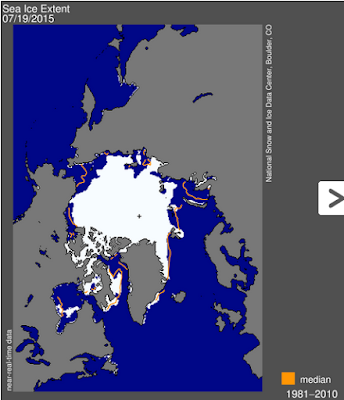
Remarkably, it appears that the Northeast Passage may be ice free by the end of July 2015, based on images posted by the National Snow and Ice Data Center. The early melting of the sea ice that usually blocks the Northeast Passage is a result of the warming of the Arctic. If the sea ice along the Northeast Passage continues to melt as rapidly as it has over the past week, it may be the earliest in the summer during recorded history that this route has been ice free and navigable without the need for an icebreaker.

Northeast Passage in Red


According to Jeff Masters "A large area of high pressure that has set up shop north of Alaska is expected to persist for the remainder of July, and is likely to bring sunny skies and a warm flow of air into the Arctic that will lead to rapid ice loss in the coming weeks"

As shown in the image below, the Northeast Passage is on the verge of becoming ice free (as of July 19, 2015).


 Sea Ice Extent

Regardless of whether 2015 is a record setting year for earliest opening of the Northeast Passage, the rapid ice melt provides another indication that we live on a warming planet. It may only be a matter of decades before the Northwest and Northeast Passages through the Arctic are navigable from August through October.

Friday, June 19, 2015

Hottest May in Recorded History Gets Minimal Play in Mainstream Media

The so-called pause in global warming has come to an end. The hottest May (2015) in recorded history should be the final nail in the coffin that puts the claim that global warming is a hoax in the same category with "the world is flat" and "mankind was created by God 6,000 years ago".

The following are a sampling of new records for global surface temperatures set recently:

May 2015 - the hottest May in recorded history
January - May 2015 - the hottest January through May in recorded history
2014 - the hottest year in recorded history.


Given how much play "the pause" in global warming has received in the mainstream media, (particularly from the Murdock owned Fox News and The Wall Street Journal), the hottest May in recorded history is news that seemingly should have received more attention. However, this result has received little play, being completely overwhelmed by articles about the Pope's encyclical calling for action on climate change. It does seem apropos though that new data supporting the Pope Francis's call for action came out concurrently.

This year is likely to be the second consecutive year of record hot global surface temperatures, an outcome I predicted 16 months ago and also being predicted by BloombergBusiness. Time will tell if a record hot calendar year 2015 is judged to be newsworthy enough to get significant play in he mainstream media.  And it will be interesting to see how the science deniers at Fox
News try to spin this news about our warming planet


Friday, May 8, 2015

Sea Level Rise May Be Accelerating in 2015

For the past few decades, the global sea level has been rising by about 1/10th of an inch per year (3.2 millimeters annually). However, it seems like the rate of rise in the sea level may be accelerating. as shown in the following chart published by the CU Sea Level Research Group.


The most recent update to this report (5/4/15) shows that the increase in sea level is well above the long term trend line.  

Time will tell whether the rise in global sea level will revert back to the trend line in the future, or if the rate of sea level rise is accelerating.

A rising sea level at a rate of 1/10th of an inch per year has frightening long term consequences. However, if the seas are rising even faster than the trend of the past few decades, it won't be long until flooding, beach erosion, and the other effects of higher sea levels become catastrophic.  


Sunday, December 21, 2014

Coal - The Confounding Energy Source for a Climate Change Worrier

It seems unlikely that I will be anointed as King of the U.S. any time soon, so my conflicted attitude about coal really is not going to be much of a difference maker. But for a "warmest" like myself that cares about the American economy, it is: a) challenging to oppose efforts to reduce the burning of coal in the U.S, but b) impossible to support restrictions on coal use that limit the economic advantage this cheap source of energy gives the U.S. 

My daughter spent a spring break in the coal country of West Virginia. She said it was devastating to see beautiful mountain tops being lopped off in order to supply coal to India. This practice is incredibly controversial even in coal country. But, as long as the number of coal burning power plants are growing in China, India, and Germany, it seems fruitless to shut down American coal burning power plants.

Much of the success European's claim in reducing CO2 emissions is simply due to their shipping many of their most pollution intensive jobs off to Asia. Thus, their regulations and taxes have had barely any impact on global releases of heat trapping gases, while sending thousands of good jobs off to Asia. (And as a side note, now that the Germans have shut down their older, but still perfectly viable nuclear plants, that country's emissions are increasing dramatically due to increased burning of coal. Small businesses and consumers in Germany are paying higher rates for electricity and German tax dollars are being spent subsidizing large industries)

Banning coal plants in the U.S. would put our economy at a huge disadvantage, while having little impact on worldwide emissions of heat trapping gases. And further, it would put the power supply at risk, unless we build a plethora of new gas fired plants, at huge expense, Burning gas releases plenty of CO2 emissions as well, and the supply of cheap gas is not infinite either.

Yet as a "warmest", I would love to see all coal plants worldwide shut down, not just due to the heat trapping gases they emit, but also because of the mercury and other toxic chemicals they put into the air, particularly the coal plants in Asia that don't use scrubber technology.Pollutants from China are being carried all the way to Lake Tahoe

It was only a couple of years ago that I was infatuated with wind and solar. Yet I now consider these energy sources only a partial solution unless reasonably price utility scale storage becomes feasible. Wind and solar offer a partial solution to reducing fossil fuel burning, but seem unlikely to be a complete solution on a global basis. 

The only complete solution to reducing the burning of coal by power plants is to come up with a technology that is cheaper than coal and does not suffer from an intermittency problem. Nuclear and/or fusion are probably the only viable candidates for a cheaper than coal solution. Advanced technology holds the potential to be far safer and cheaper than existing nuclear technology. Regulations and taxes that penalize U.S. businesses are unlikely to pass in the current Congress, nor is tax payer supported funding of solar and wind technology development. 

Now I am really getting off topic, but here is my latest rant.

It is only in the context of the U.S. Budget that $3 billion can be considered chump change, but that is the case as far as spending by the U.S government on advanced energy technology. And that $3 trillion is fragmented in so many ways that the sum of the parts is way less than the total would suggest.

Not that I have anything against NASA, but it seems ridiculous to me that our government is spending $18 billion on NASA and less than $3 billion on advanced energy technology. Here are excepts that show how fragmented the spending is:

The Department of Energy's (DOE) budget includes

Fusion Energy Sciences:
The FY 2014 appropriation was $504.7 million
The FY 2015 request is $416.0 million, a decrease of $88.7 million or 17.6 percent
The House bill provides $540.0 million, an increase of $35.3 million or 7.0 percent above current funding
The report has two pages detailing the committee’s funding recommendations and guidance for the fusion energy sciences program.  It gives strong support for the domestic fusion program.     
High Energy Physics:
The FY 2014 appropriation was $796.5 million
The FY 2015 request is $744.0 million, a decrease of $52.5 million or 6.6 percent
The House bill provides $775.0 million, a decrease of $21.5 million or 2.7 percent below current funding
There is lengthy report language.  
Nuclear Physics:
The FY 2014 appropriation was $569.1 million
The FY 2015 request is 593.6 million, an increase of $24.4 million or 4.3 percent
The House bill provides $600.0 million, an increase of $30.9 million or 5.4 percent above current funding
The report includes language pertaining to the 12GeV Continuous Electron Beam Accelerator, the Relativistic Heavy Ion Collider, and the Facility for Rare Isotope Beams.
DOE Office of Nuclear Energy

  • DOE’s Office of Nuclear Energy is funded at $914 million, an increase of $24.3 million over the FY14 funding level. Nuclear energy research and development programs that receive funding within the $914 million allocation include several of the following:
    • The Idaho Operations and Infrastructure account, which covers infrastructure maintenance and improvements at Idaho National Laboratory, is funded at $200.6 million – a $20 million increase over last year.
    • The National Science User Facility program is funded at $36.5 million – an increase of $18 million above the President’s request.  Increases under this program are directed to fully complete the installation of post-irradiation examination equipment at INL’s Irradiated Materials Characterization Laboratory (IMCL).
    • Small Modular Reactor Licensing Support Programs are funded at $55 million.   This funding is slated for NuScale Power’s Small Modular Reactor which is proposed for construction in Idaho.
    • The Light Water Reactor Sustainability program, which is managed by INL and promotes the continued safe operation of America’s existing nuclear reactors, is funded at $35 million, an increase of $5 million over FY14 and the budget request.
    • The Reactor Concepts Research, Development, and Demonstration account is funded at $133 million – an increase of $20 million above fiscal year 2014 and $32.5 million above the President’s request. Within the overall $133 million level for this account, $33 million is allocated to fuel qualification for the High Temperature Gas Reactor, $11 million above the budget request.
    • The Advanced Fuels program within Fuel Cycle Research and Development is funded at $60.1 million, the same as last year and $17 million above the President’s budget request, and Used Nuclear Fuel Disposition research and development is funded at $49 million, $19 million above FY14.
  • Within the Office of Naval Reactors, the bill includes $68 million for the operation of the Advanced Test Reactor, an increase of $1.5 million above FY14.
  • Within the Office of Electricity Delivery and Energy Reliability, the bill includes $5 million to continue development of an Electric Grid Test Bed program to enhance existing full-scale electric grid testing capabilities like those at Idaho National Laboratory.
  • The bill also provides $380 million for cleanup activities associated with the Idaho Cleanup Project and the Advanced Mixed Waste Treatment Project co-located on the Idaho desert with Idaho National Laboratory. This represents an increase of $13 million above the President’s request to fully support workplan alignments needed for Idaho’s transuranic waste program as a result of the closure of the Waste Isolation Pilot Plant. 
  • Includes an additional $2 million for the National Spent Fuel Program, putting the unique expertise of INL to work in order to provide solutions for managing the Department of Energy’s inventories of spent nuclear fuel.
  • Prohibits the U.S. Corps of Engineers from requiring Clean Water Act section 404 permits for certain agricultural activities, such as construction and maintenance of farm or stock ponds or irrigation ditches.
  • Directs the U.S Environmental Protection Agency and the U.S. Department of the Army to withdraw the interpretive rule, “U.S. Environmental Protection Agency and the U.S. Department of the Army Interpretive Rule Regarding the Applicability of the Clean Water Act 4 Section 404(f)(1)(A).” Section 404 of the Clean Water Act exempts certain agricultural activities, such as soil and water conservation practices, from regulation. The interpretive rule would have limited that exemption significantly. 


Related Posts